


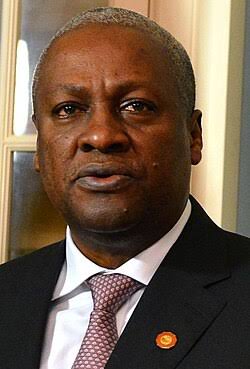
Ghana’s President, John Mahama, has described the conditions attached to a proposed United States health compact as “humiliating,” explaining why Ghana rejected the agreement, Graphic Online reported on Monday.
Mahama made the remarks during a conversation at the Council on Foreign Relations in New York on Friday, September 25, where he discussed Ghana’s decision to reject the US health compact.
According to the report, the proposed compact was intended to replace health funding previously provided through the United States Agency for International Development.
Mahama said Ghana subjected the document to due process, with the Ministry of Health reviewing it before presenting an Information Paper to Cabinet. He said several provisions were flagged, including requirements for Ghana to provide the US with its pathogen profile and medical records.
“It states that we shall give the United States our pathogen profile. It also says we should give our medical records. I mean, who takes another country’s medical records?” Mahama said.
The Ghanaian President said the compact also required the country to commit a specified amount as counterpart funding. He added that the agreement stipulated that medicines and other medical products supplied under the programme would not be subject to inspection by Ghana’s Food and Drugs Authority.
“It was humiliating,” Mahama said, adding that Cabinet rejected the compact in what he described as record time.
“It was the compact that was thrown out in record time in our Cabinet. I’ve never seen anything thrown out as fast as that. And so, of course, we rejected it,” he said.
Mahama said the Health Minister was subsequently directed to inform the US Ambassador that Ghana would manage without the proposed arrangement.
“We said ‘no, we don’t want it’ and we’re doing fine,” he added.
Ghana rejected the bilateral health deal earlier in 2026 after negotiations broke down over concerns about the sharing of sensitive health data, Reuters reported in April. The proposed agreement would have provided about $109m in US health assistance over five years, according to a source familiar with the negotiations.
Mahama also linked the rejection of the compact to the Accra Reset, an initiative aimed at reducing Africa’s dependence on external health financing and strengthening local capacity to produce medicines and vaccines.
He said the withdrawal of $174m that had been programmed into Ghana’s national budget created significant funding gaps in the education and health sectors, with the health sector alone facing a reported annual shortfall of $74m.
The President said the experience reinforced the need for African countries to build stronger and more self-reliant health systems.