


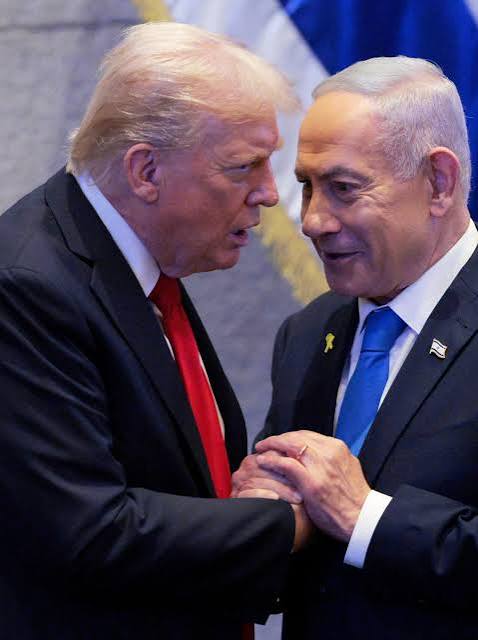
US President Donald Trump has announced plans to end America’s annual military assistance to Israel by the end of 2026, signalling a potentially significant shift in one of Washington’s longest-standing strategic and financial commitments in the Middle East.
Trump made the announcement on Tuesday during an interview on American television programme Fox & Friends, arguing that Israel had developed sufficient economic and military strength to sustain its defence requirements without depending on billions of dollars in American assistance.
According to the US president, the decision followed discussions with Israeli Prime Minister Benjamin Netanyahu, who he said had agreed that the country no longer needed the financial support.
“We were giving them $4 billion – we are – but it gets cut off at the end of the year,” Trump said.
He maintained that Washington would continue to assist Israel if circumstances required it, particularly if the country faced serious security challenges.
“We’ll help Israel if they need it,” he said, describing Israel as America’s most important ally and noting that it had received more assistance from the United States than any other country.
Trump also suggested that the decision was partly motivated by growing domestic political opposition to American military assistance to Israel.
Referring to Democratic Senate candidate Abdul El-Sayed, who has criticised unconditional US support for Israel, Trump questioned why Washington should continue providing financial assistance that had increasingly become a subject of political controversy in America.
“Why should we suffer the slings from lunatics like an El-Sayed when they don’t need it?” he asked.
The proposed withdrawal represents a major development in a security relationship that has seen Israel emerge as the largest cumulative recipient of American foreign assistance since the Second World War.
According to the Congressional Research Service, the United States had provided Israel with approximately $175 billion in bilateral assistance and missile defence funding in current dollars by 2025. When adjusted for inflation, the cumulative figure approaches $300 billion.
Although American assistance initially included substantial economic support, its emphasis gradually shifted towards military financing, particularly from the 1970s onwards.
The relationship received a significant boost following the 1973 Yom Kippur War, when the United States undertook extensive military resupply operations to help Israel replenish its weapons and military equipment.
Over subsequent decades, successive American administrations maintained and expanded military cooperation with Israel, supplying advanced weapons, financing defence procurement and supporting missile defence systems.
In 1999, the Clinton administration and the Israeli government established a 10-year assistance framework worth approximately $26.7 billion.
This was followed in 2007 by another agreement under President George W. Bush, committing Washington to $30 billion in military assistance over the 2009–2018 period.
The most recent arrangement was signed on September 14, 2016, under former President Barack Obama and Netanyahu’s government.
The 10-year memorandum of understanding committed the United States to providing $38 billion in military assistance between 2019 and 2028, subject to congressional appropriations.
The package comprises $33 billion in Foreign Military Financing grants and another $5 billion earmarked for missile defence programmes.
Under the arrangement, Israel receives approximately $3.8 billion annually, comprising $3.3 billion for military procurement and $500 million for missile defence cooperation.
The funding has helped Israel acquire sophisticated American military equipment and maintain its technological advantage over potential adversaries in the region.
American assistance also expanded considerably following the October 7, 2023 Hamas attacks on Israel and the subsequent regional conflicts. In 2024, Congress approved additional emergency assistance, pushing total US assistance obligations to Israel to approximately $12.5 billion for that year.
Trump’s announcement also comes against the backdrop of Netanyahu’s stated desire to reduce Israel’s dependence on American financial assistance.
The Israeli prime minister has previously argued that his country should gradually develop greater military and defence-industrial independence.
In January, Netanyahu told The Economist that he hoped to achieve a substantial reduction in Israel’s reliance on American assistance within a decade.
He subsequently told American broadcaster CBS in May that he wanted US financial support to eventually reach “zero”.
In June, he again advocated greater Israeli military autonomy, arguing that the country needed to strengthen its capacity to produce weapons and meet its own defence requirements.
Despite Netanyahu’s position, the proposed termination raises questions about how Israel will finance its military procurement and missile defence programmes, particularly given the scale of its regional security commitments.
There are also uncertainties surrounding the implementation of Trump’s announcement. The existing 10-year memorandum runs through 2028, while American military assistance is subject to congressional appropriations. Any early termination or restructuring would therefore involve questions of congressional authority, existing commitments and future defence cooperation.
For now, Trump has indicated that the end of direct annual assistance would not necessarily mean an end to American military support for Israel, insisting that Washington would remain available should its ally require assistance.