


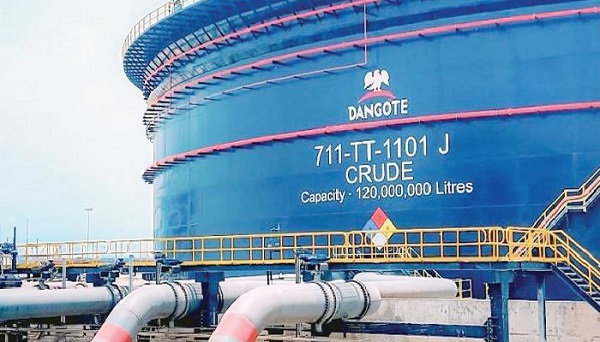
Dangote Petroleum Refinery has reset the pricing framework for refined petroleum products, fixing the ex-depot price of Premium Motor Spirit (petrol) at $0.779 per litre and formally transitioning to a dollar-denominated sales model.
The move effectively ends naira-based transactions for most refined products, marking a decisive shift from the naira-for-crude arrangement introduced in October 2024. It also signals a broader recalibration of the refinery’s commercial strategy as it deepens its role as Nigeria’s dominant supplier in a deregulated downstream market.
Under the new pricing structure, Automotive Gas Oil (diesel) is set at $1.087 per litre, while Aviation Turbine Kerosene is priced at $0.942 per litre. Coastal deliveries of petrol are benchmarked at $1,044.62 per metric tonne. The revised rates took effect on July 13, 2026, with the refinery invalidating all previously issued naira-denominated proforma invoices and deal recaps.
In a formal notice to marketers and customers, the company directed that no payments be made against earlier naira invoices, confirming that all transactions—gantry and coastal—will now be conducted in U.S. dollars. However, it clarified that Liquefied Petroleum Gas (LPG) remains excluded from the new pricing regime.
Currency Alignment Over Policy Sentiment
At its core, the transition reflects a structural adjustment rather than a policy reversal. Industry sources indicate that the refinery has increasingly sourced crude oil in dollars, particularly from the Nigerian National Petroleum Company Limited (NNPCL), while continuing to sell a large share of its output domestically in naira.
This currency mismatch—buying inputs in dollars and selling outputs in naira—has exposed the refinery to foreign exchange risk, especially amid exchange-rate volatility and fluctuating global crude prices. The shift to dollar pricing is therefore aimed at restoring currency alignment across its supply chain and protecting operating margins.
One industry insider described the move as “a necessary correction,” noting that the imbalance between dollar-denominated crude procurement and naira-based product sales had become unsustainable.
Implications for Marketers and Pump Prices
The immediate impact will be felt by petroleum marketers, who now face direct exposure to foreign exchange movements when sourcing products from the refinery. This is likely to introduce a new layer of pricing variability in the downstream market.
While the refinery’s dollar benchmark establishes a base cost, final retail pump prices will continue to depend on several variables—including the naira exchange rate, logistics and distribution costs, regulatory charges, and competitive dynamics among suppliers.
In effect, petrol pricing in Nigeria will become more tightly linked to both global oil markets and domestic currency performance.
The development also casts fresh uncertainty over the sustainability of the government’s naira-for-crude policy, which was designed to reduce pressure on foreign exchange demand, support local refining, and stabilise fuel prices.
Although the policy initially enabled refiners to transact in naira, implementation challenges have persisted. Market participants report that a growing share of crude supply has reverted to dollar-based transactions, undermining the policy’s original intent.
Dangote Refinery’s shift underscores these constraints, highlighting the difficulty of sustaining a dual-currency system in a market still heavily influenced by global pricing benchmarks and foreign exchange realities.
A Market Now Anchored to Dollars
With this transition, Dangote Refinery has effectively redefined the pricing anchor for Nigeria’s downstream petroleum sector. As the country’s largest supplier of refined fuels, its pricing decisions carry significant weight and are closely watched by industry participants.
From now on, the interplay between exchange rates, crude oil prices, and domestic distribution costs will play an even more decisive role in determining what consumers ultimately pay at the pump.
In practical terms, Nigeria’s fuel market has moved one step closer to full exposure to global market forces, where currency stability is as critical as crude supply in shaping price outcomes.
:::