


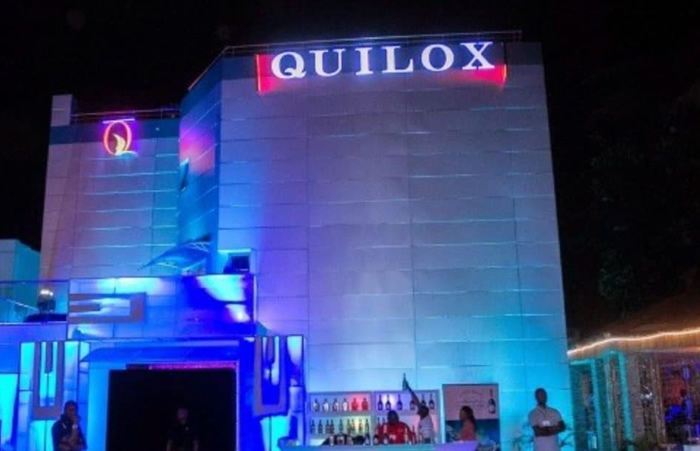
Management of Quilox Nightclub has welcomed a new industry report by Moniepoint, which identifies the luxury venue as one of the leading revenue drivers in Nigeria’s fast-expanding nightlife economy—now estimated at approximately ₦900 billion annually.
The Moniepoint Nightlife Transaction Report, a data-led analysis of payment flows across bars, nightclubs, lounges, restaurants, and event centres nationwide, provides one of the clearest empirical snapshots yet of Nigeria’s after-hours economy. Drawing from millions of digital transactions processed on its platform, the report highlights both spending patterns and geographic concentrations of nightlife activity.
According to the findings, Victoria Island—home to Quilox—emerged as the country’s highest-grossing nightlife district when measured by per capita transaction value. Within that ecosystem, Quilox was profiled as a dominant player in the premium segment, driven by high-value customer spend and a consistent upscale clientele base.
Reacting to the report, Quilox management described the recognition as a data-backed validation of its long-standing premium positioning within Nigeria’s entertainment landscape. While the club declined to disclose specific revenue figures, it noted that its VIP table model—structured around high minimum spend thresholds—places it squarely within the upper tier of venues captured in the report.
“The report confirms what we have always known: Nigerian nightlife is serious business,” an official of Vibe Tribe Entertainment said. “And at the top of that business, Quilox is where the numbers are.”
Beyond venue-level insights, the Moniepoint report also underscores a broader structural shift: the increasing digitisation of payments within Nigeria’s nightlife sector. Analysts say this transition is crucial to understanding the revised ₦900 billion valuation, which marks a significant upgrade from earlier informal estimates that relied heavily on anecdotal data.
Nigeria’s digital payments ecosystem has grown rapidly in recent years, with total transaction values now exceeding hundreds of trillions of naira annually across all sectors. Industry data indicates that:
- Monthly digital transaction volumes routinely exceed ₦50–₦70 trillion across banking channels, fintech platforms, and card networks.
- Every year, total digital payments in Nigeria are estimated to surpass ₦600 trillion, driven by mobile transfers, POS transactions, and online payments.
Within this broader payments landscape, nightlife represents a high-frequency, high-value niche segment, particularly in urban areas such as Lagos and Abuja. The adoption of POS terminals, instant bank transfers, and QR-based payments in clubs and lounges has significantly improved transaction visibility, allowing firms like Moniepoint to generate more accurate sectoral insights.
However, analysts caution that the ₦900 billion estimate may still understate the true size of the nightlife economy. A substantial portion of smaller bars, informal parties, and pop-up events continue to operate largely on cash, limiting full capture within digital datasets.
The report’s release coincides with Quilox’s Season 13 relaunch, alongside its strategic expansion into adjacent revenue streams. These include Q Studio’s content streaming and licensing operations, as well as ongoing efforts to secure accreditation for the Quilox Nightlife Institute—an initiative aimed at formalising training within the hospitality and nightlife sector.
Founded in 2013 by Shina Peller, Quilox has grown from a high-end Lagos nightclub into what its management describes as a multi-billion-naira entertainment enterprise. The company also credits its Chief Operating Officer, Akinlabi Abiola-Peller, with strengthening internal financial systems and operational efficiency—factors it says have positioned the brand within the revenue bracket highlighted in the Moniepoint report.
Taken together, the findings reinforce a clear trend: Nigeria’s nightlife industry is no longer an informal, loosely tracked segment of the economy, but an increasingly structured, data-visible market—one where premium operators like Quilox are setting the pace for scale, monetisation, and financial sophistication.