


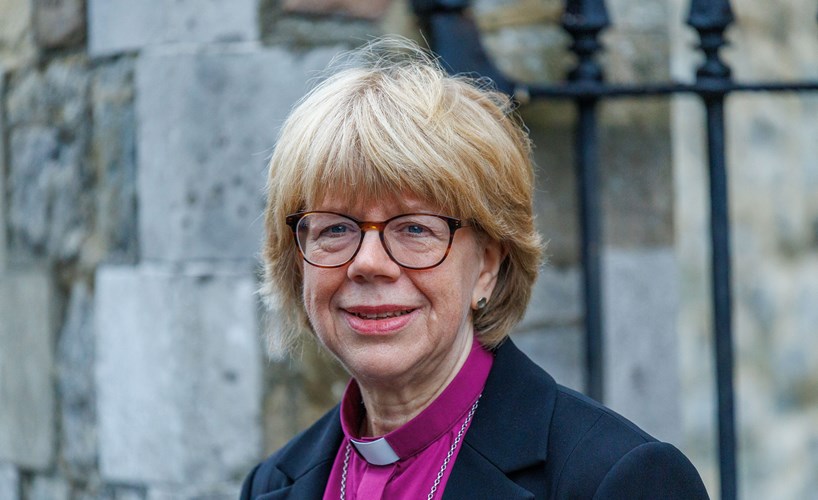
A former nurse stepped into one of Christianity’s oldest and most symbolically powerful offices on Wednesday, as Sarah Mullally was enthroned as Archbishop of Canterbury—the first woman to lead the centuries-old mother church of the world’s 85 million-strong Anglican community.
Inside the soaring nave of Canterbury Cathedral, before a congregation of about 2,000 that included Prince William and Catherine, Princess of Wales, the ceremony unfolded with centuries-old ritual. It began at the cathedral’s west door, where Mullally struck three times with a staff to request entry—a symbolic gesture of humility and calling.
Dressed in deep yellow-gold robes, she was welcomed by local schoolchildren who asked why she had come.
“I am sent as archbishop to serve you, to proclaim the love of Christ and with you to worship and love him with heart and soul, mind and strength,” she replied.
The service culminated in her being seated in two thrones, representing the dual nature of the role: as bishop of the Canterbury diocese and as the spiritual figurehead of the global Anglican Communion.
At 63, Mullally assumes office at a moment of both renewal and reckoning for the Church of England. Her predecessor, Justin Welby, resigned in November 2024 following a damning report that found the church had covered up a serial abuse case dating back to the 1970s and failed to act when allegations resurfaced decades later.
Mullally has made safeguarding a central priority, pledging to “do all I can to ensure that the Church becomes safer and also responds well to victims and survivors of abuse.” In recent remarks, she said the institution must become more “trauma-informed,” placing the experiences of survivors at the heart of its response.
Her ascent is also the culmination of a personal journey that mirrors the church’s slow, often contentious evolution. Before entering ministry, Mullally spent more than three decades in Britain’s National Health Service, rising to become chief nursing officer for England in 1999. Ordained as a priest in 2002, she went on to become Bishop of London in 2018—the first woman to hold one of the church’s most senior posts, just four years after women were finally admitted to the episcopate.
Yet her historic appointment also throws into sharp relief the enduring divisions within global Anglicanism.
The Archbishop of Canterbury, a role dating back to the sixth century, is regarded as the symbolic leader of a worldwide communion that spans more than 160 countries. But that communion is far from unified. While some provinces, particularly in the West, have embraced women in leadership for decades, others remain firmly opposed.
In parts of Africa—now a demographic and theological powerhouse within Anglicanism—resistance has been especially pronounced. Leaders such as Laurent Mbanda have argued that scripture reserves episcopal authority for men, a position shared by several conservative provinces across the continent.
Those tensions reflect deeper fault lines over authority, tradition, and biblical interpretation—divisions that have already been strained by disputes over sexuality and church governance. Mullally’s leadership will therefore be tested not only in restoring trust at home but also in holding together a global fellowship where her very position is not universally accepted.
The Church of England itself was born out of rupture, when Henry VIII broke from Rome in the 1530s, placing the English monarch—today still the church’s supreme governor—at its head. That legacy of reform and resistance continues to shape its identity.
Now, as its 106th Archbishop takes her seat, Mullally embodies both continuity and change: a figure rooted in tradition, yet emblematic of a church still negotiating its future—between history and modernity, unity and difference.
The office Mullally now occupies dates back more than 1,400 years, making it one of the oldest continuous ecclesiastical roles in Christianity. Its modern form, however, emerged after Henry VIII broke from Rome in the 1530s, establishing the Church of England as a national church under the English crown.
Since then, the Archbishop of Canterbury has functioned both as a diocesan bishop and as the symbolic head of the worldwide Anglican Communion—a fellowship of about 85 million Christians across more than 160 countries. Unlike the centralized authority of the Roman Catholic Church, the Anglican Communion is a loose, often fractious network of autonomous provinces.
That structural looseness has made doctrinal disputes—especially over gender and sexuality—more difficult to resolve.
Mullally’s elevation is the culmination of a slow and contentious evolution within Anglicanism. Women were first ordained as priests in the Church of England in 1994, after years of fierce internal debate. It took another two decades before the church approved women as bishops in 2014.
Her own rise reflects that trajectory: ordained in 2002, she became Bishop of London in 2018—one of the most senior roles in the church—before now ascending to Canterbury.
Globally, the Anglican world has been uneven on this issue. The first woman bishop in the Communion was consecrated in the United States in 1989, but acceptance has varied widely across regions.
The most sustained opposition to women bishops—and now to a woman Archbishop of Canterbury—has come from parts of Africa, where Anglican churches are numerically strong and theologically conservative.
Leaders such as Laurent Mbanda of Rwanda have argued that scripture mandates male episcopal leadership, reflecting a broader view held by several provinces across sub-Saharan Africa. For these churches, the issue is not merely institutional but doctrinal, tied to interpretations of biblical authority and tradition.
African provinces—particularly in countries like Nigeria, Uganda, and Rwanda—now represent a significant and growing share of global Anglicanism. Their resistance has, at times, strained relations with the Church of England and other Western provinces, which are generally more progressive on gender and sexuality.
The disagreement is part of a wider realignment within global Christianity, where demographic growth in the Global South is shifting influence away from Europe and North America.
The controversy over women’s ordination intersects with other divisive issues, especially same-sex marriage and LGBTQ inclusion. These disputes have led to periodic boycotts of global Anglican gatherings by conservative provinces and have raised questions about the authority of the Archbishop of Canterbury as a unifying figure.
Mullally’s leadership will therefore be tested not just domestically but internationally—particularly in maintaining cohesion within a Communion where her own appointment is not universally accepted.
Her enthronement also comes at a moment of institutional reckoning. Her predecessor, Justin Welby, resigned following revelations that the Church of England failed to adequately respond to a serial abuse case dating back decades.
The scandal intensified scrutiny of safeguarding practices within the church and eroded trust among congregants. Mullally has signaled that restoring credibility—especially through a more survivor-centered, trauma-informed approach—will be central to her tenure.