


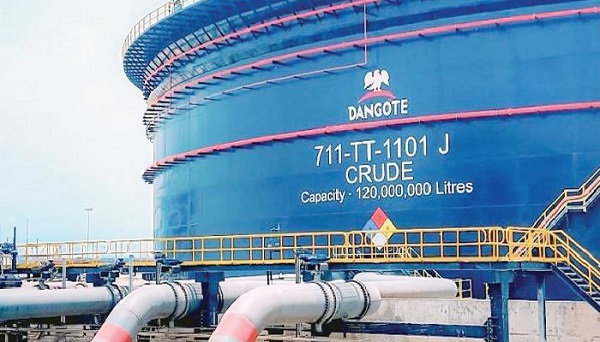
For millions of Nigerian investors, the road to owning a piece of the Dangote Petroleum Refinery may soon become much shorter — and potentially start with as little as N5,250.
The Dangote Petroleum Refinery and Petrochemicals has taken a major step towards its planned entry into the Nigerian capital market, signing the documents for a proposed N2.15 trillion ($1.6 billion) initial public offering (IPO) ahead of the expected opening of the offer on September 14.
The transaction is more than another corporate share sale. If approved and completed as planned, it would bring one of Africa’s most strategically important industrial assets to the Nigerian Exchange (NGX), opening the refinery’s ownership to a potentially unprecedented number of retail and institutional investors.
The preliminary signing ceremony, held on Monday, brought together the refinery, financial advisers, regulators and other parties involved in the transaction as preparations intensify for the offer.
The IPO is subject to the approval of the Securities and Exchange Commission (SEC).
According to Olutade Olaegbe, managing director, investment banking at Vetiva Capital Management Limited, the offer is scheduled to open on September 14 and close on October 13, subject to regulatory approval.
The refinery is expected to list on the main board of the NGX in November 2026.
At an offer price of N525 per share, investors will be able to subscribe for a minimum of 10 shares, putting the entry cost at N5,250. Subsequent subscriptions will be made in multiples of 10 shares.
That relatively low entry point is deliberate.
The refinery is targeting participation from as many as 10 million retail investors, potentially turning the IPO into one of the broadest attempts to bring ordinary Nigerians directly into the ownership of a major industrial company.
All investors — retail and institutional — will subscribe at the same fixed offer price, with payment required in full when applications are made.
The shares offered will rank equally with the refinery’s existing ordinary shares once allotted and listed.
The scale of the proposed transaction is what makes the offer particularly significant.
At about N2.15 trillion, or $1.6 billion, the IPO would represent a major capital-market transaction by Nigerian standards.
Olaegbe said proceeds from the IPO would be used to fund growth capital expenditure for the refinery.
Perhaps the most striking feature of the offer is its attempt to put the refinery within reach of ordinary investors.
At N5,250 for the minimum 10 shares, the financial barrier to entry is relatively low compared with the scale of the asset being offered.
For a retail investor, however, the low minimum subscription should not be confused with a guarantee of allocation or returns.
If demand is significantly higher than the number of shares available, investors may receive fewer shares than they apply for. The IPO also includes an oversubscription provision that could allow the issuer to increase the offer size by as much as 30 percent, subject to SEC approval and demand.
The refinery has also proposed an incentive for qualifying retail investors. Eligible participants could receive up to two additional shares if they hold their allotted shares for a prescribed minimum period, with the exact conditions expected to be set out in the prospectus.
The incentive could encourage retail investors to remain invested beyond the initial listing rather than immediately selling their shares.
For institutional investors, the calculation is likely to be considerably more detailed.
Pension funds, asset managers, insurance companies and other large investors will be looking beyond the N525 offer price and the size of the refinery.
They will want to understand the company’s financial performance, projected cash flows, debt obligations, capital expenditure requirements, dividend policy, crude supply arrangements, refining margins, foreign-exchange exposure and the broader outlook for Nigeria’s downstream petroleum sector.
The refinery’s scale gives it significant strategic importance, but scale alone does not determine investment returns.
Institutional investors will also be assessing the valuation implied by the IPO and whether the expected earnings and cash flows justify the price at which the company is being offered to the market.
Another potentially important consideration is the refinery’s proposed dollar-denominated dividend arrangement.
Chuka Eseka, group managing director and chief executive officer of Vetiva Capital Management Limited, said the transaction had been structured to meet Nigerian capital-market disclosure requirements while reflecting the nature and strength of the issuer.
He pointed specifically to the proposed payment of company dividends in dollars.
For investors, that could introduce an important dimension to the investment case, particularly in an economy where exchange-rate movements can materially affect the real value of naira-denominated returns.
The IPO could also become a test of the depth of Nigeria’s capital market.
With a target of up to 10 million retail investors, the transaction is effectively asking whether a large population of Nigerians can be brought into the formal ownership of a major productive asset through the stock market.
That could have consequences well beyond Dangote Refinery.
A successful offering could demonstrate to other large Nigerian companies that there is sufficient domestic appetite for substantial equity offerings. It could also deepen retail participation on the NGX and potentially encourage more companies to consider public listings.
The flip side is that such a large transaction could absorb a significant amount of available investment capital.
For fund managers and institutional investors, the question will be whether allocating substantial capital to Dangote Refinery leaves enough room in portfolios for other opportunities.
For retail investors, the IPO could compete for savings with government securities, bank deposits, mutual funds and other equities.
In other words, the Dangote IPO is not entering an empty market. It will be competing for the same pool of Nigerian and international capital that is already chasing other investment opportunities.
Retail investors will be required to apply electronically through designated channels, including participating banks, specified fintech platforms and stockbroking platforms.
Qualified institutional investors will have the option of subscribing electronically or completing investor application forms and submitting them through receiving agents identified in the offer document.
The offer will be made at a fixed price of N525 per share, meaning investors will not be bidding against one another to determine the final price.
The minimum subscription is 10 shares, or N5,250.
Applications above the minimum must be made in multiples of 10 shares.
The offer is expected to remain open for about one month, from September 14 to October 13, subject to regulatory approval.
The immediate question for investors may be simple: how many shares can I get?
The more important question is what those shares will ultimately be worth.
The IPO gives Nigerians an opportunity to own part of an industrial project that has already transformed the country’s refining landscape. But once the refinery becomes a listed company, investors will judge it by the same standards applied to other public companies — earnings, cash generation, governance, dividends, growth and returns on capital.