


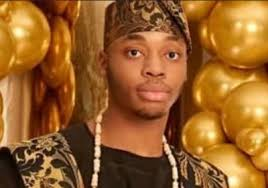
At 22, Raheem Okoya carries a name that opens doors — and invites scrutiny. The son of billionaire industrialist Razaq Okoya says he is determined to prove that privilege is not a substitute for performance.
In a recent interview with BBC News Pidgin, the young Executive Director of Eleganza Industries pushed back against the perception that his lifestyle is bankrolled solely by his father’s vast fortune.
“I’m not just spending the chairman’s money; I work. I earn a salary. I have investors. People believe in my music and put money behind it,” he said.
The Okoya Legacy: From Market Stall to Manufacturing Empire
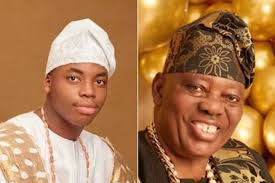
To understand the weight on Raheem’s shoulders, one must understand the legacy he inherited.
His father, Razaq Okoya, is one of Nigeria’s most prominent industrialists — a self-made magnate who built the Eleganza brand from modest beginnings into a household name in manufacturing, spanning plastics, household goods, and consumer products. Unlike many second-generation heirs, Raheem is keen to emphasize that wealth, in his family, was engineered — not inherited.
“My dad wasn’t born rich,” he noted. “He tries to instil those values in his kids. He wants his kids to also be able to work and build a fortune rather than just spend and destroy.”
According to Raheem, his elevation to Executive Director was not ceremonial. He spent a decade understudying his father — learning operations, management culture, and the discipline that built the empire.
“I’ve been learning this position my whole life. From when I was in school, I’ve been shadowing my dad. It’s not an overnight thing. It’s been 10 years in the making.”
Young, Watched, and Judged

Still, competence must compete with optics.
“It’s definitely challenging. It’s a heavy responsibility. People already look at you — you’re young. They already want to doubt you. You always have to prove that you know what you’re talking about.”
For Raheem, leadership is not just about boardrooms. It is also about perception management — particularly in an age where social media narratives can harden into public verdicts.
“I don’t like fake news. I hate fake news. The media likes to put me up as a villain. They know what gets people riled up. It’s not always the truth,” he said.
“They will take a little thing or completely change the narrative and perspective on me. It’s not nice. It’s painful.”
Beyond the Boardroom: Raised on Fuji

Business may be his inheritance, but music is his passion.
Raheem credits Fuji legend King Wasiu Ayinde Marshal — popularly known as K1 — as a formative presence in his upbringing.
“K1 is a legend. He used to ring in the corridors of my house,” he recalled.
Unlike the caricature of a billionaire’s son dabbling in music as a hobby, Raheem insists his artistic journey is commercially structured, backed by private investors who believe in his sound.
A Son’s Ambition
Strip away the headlines, and what remains is something disarmingly simple: a son trying to justify his father’s faith.
“I love my dad so much. He’s my number one hero, my mentor. I just hope I can really, really make him proud one day.”
For Raheem Okoya, the challenge is not access — it is authenticity. In a society quick to dismiss heirs as beneficiaries rather than builders, he is wagering that discipline, diversification, and time will eventually rewrite the narrative.